
What is cultural consulting?
A book can be translated perfectly and still fail to connect with its intended audience.
Every book market has its own conventions: reading habits, visual trends, publishing standards, cultural references and linguistic sensibilities. What works for English- or Spanish-speaking readers won’t necessarily have the same impact in France.
Drawing on my knowledge of the French book market and its specific characteristics, I help you adapt your editorial choices to French-speaking readers.
The aim? To avoid cultural missteps, awkward wording and decisions that could blur your message or undermine your book’s appeal.
I offer an informed, independent perspective on how your project is likely to be perceived by French readers, before it goes to publication.
Seeing your book through French readers’ eyes
Adapting a book for a new market involves much more than getting the language right.
What kind of projects can I help with?
In-depth knowledge of the French book market
The perspective of both a literary translator and a published author
As a literary translator, I work every day with texts from different cultures. I understand the challenges posed by cultural references, wordplay, idiomatic expressions and the conventions of different languages. But my experience goes beyond translation.
As a published author, I also know the realities of the French book market: what readers look for, the conventions of different genres, the importance of a title or cover, and how books are presented in bookshops and online stores. I regularly attend literary festivals and conventions, where I meet readers face to face and see what catches their eye, sparks their curiosity and makes them want to buy a book.
This combination of experience allows me to offer advice from linguistic, editorial and commercial perspectives, while always keeping what matters most in mind: your book and what makes it unique. My aim isn’t to reshape your project just to make it fit a category. It’s to help you present it in the best possible light to French readers.
Cultural consulting
Depending on your needs, my support may include:
Estimated turnaround: from a few days to several weeks, depending on the scope of the project.
A real-life example: can you judge a book by its cover?
A cover that sells brilliantly in one market may fall flat in another!
A cover is often the first thing a reader notices. It immediately sets expectations about genre, atmosphere, tone and the kind of story they’re about to discover. But visual conventions aren’t universal.
A cover that works beautifully for British readers may seem too busy, too dark, too childish or simply out of place in the French market. Conversely, a cover perfectly suited to French readers may not meet the expectations of an English-speaking audience.
The point isn’t to change things for the sake of it. It’s to understand what your cover and title are actually communicating to your future readers.
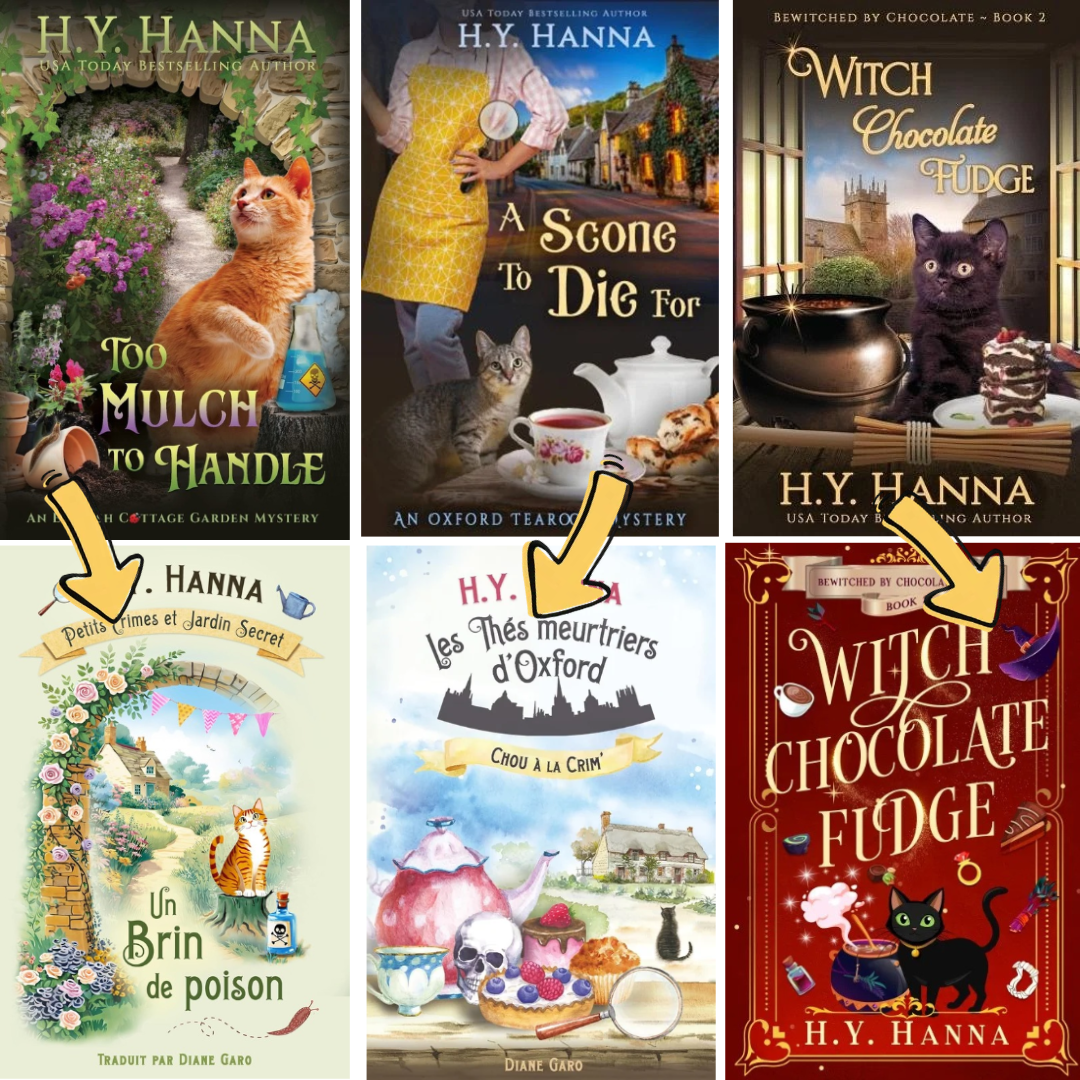
These examples show how a series’ visual identity can be adapted to appeal to a new readership while retaining the elements that make it distinctive. Depending on the genre, French readers may respond to different visual cues, atmospheres and conventions. A cover needs to do more than reflect the book’s contents: it must also send the right signals to its intended audience. Readers should be able to recognise at a glance the kind of book they might enjoy.
A few more examples
Literary categories don’t always translate neatly from one market to another. In France, polar can cover everything from detective fiction to thrillers, whereas English-speaking markets tend to distinguish more clearly between mystery, crime fiction and thriller. Choosing the right category also means reaching the right readers.
Audi’s electric car model, e-tron, sounds almost exactly like the French word étron (meaning “turd”). Not exactly the most flattering association! A reminder of why it’s worth checking how a name sounds and what it might suggest before launching it in another country.
In France, red is often associated with passion or danger, while in many Chinese traditions it symbolises luck and prosperity. White, a colour associated with purity and weddings in Western cultures, can be linked to mourning in parts of Asia. Something to bear in mind when adapting a book cover for a new market!
In France and several other European countries, Disney’s film Moana was released as Vaiana. Why? The name Moana was already protected as a trademark in certain European territories. Another good reason to check whether a title is available in your target markets before settling on it.
Frequently asked questions
Not at all. It can be useful at any stage of your project: before translation, when choosing a title or cover; during the translation process; or just before publication, to make sure every element is suited to the French market.
Absolutely. I provide an independent assessment and recommendations on how well your cover is likely to work in the French market: whether the genre is clear, the atmosphere feels right, the promise to the reader is appropriate, and the design is legible and consistent with your editorial positioning. I don’t create illustrations or graphic designs, but I can help you make informed decisions and communicate your ideas to your designer.
I can carry out preliminary searches to identify identical or very similar titles, particularly in the book market, and flag any potential risk of confusion. French law has specific rules concerning plagiarism and the protection of titles, which may differ from those in other countries. The relevant databases and checks can also vary. My research is an initial editorial and commercial check, not a comprehensive legal clearance or guarantee that a title is available.
No. I work with independent authors, publishers, literary agencies and international publishing professionals looking to adapt their books and content for the French market.
Payment is made by bank transfer in two instalments. The first 50% is due when the contract is signed (for translation projects) or the quote is accepted (for other services). The remaining 50% is payable upon delivery.
My human translation services include adapting cultural references, expressions and wording for French-speaking readers. Depending on the project, they may also include cover analysis, advice on title positioning or marketing recommendations. However, more in-depth editorial consulting is not included in my AI-assisted translation service. It is offered separately and can be booked independently at €50 per hour.